
Okay. I don’t play a lot of job simulators, or at least I don’t seem to play them for very long. But… I’m going to need to fill in some backstory on how I came to be looking for and ultimately purchasing this Seafarer: the Ship Sim.
It all goes back to Renowned Showman P. T. Barnum, and particularly the musical The Greatest Showman, starring Hugh Jackman in a show that, at times, came close to portraying the life and times of Connecticut politician P. T. Barnum. I mean by that, that the musical was nothing like reality, but ya know, I really liked the music and the dancing and stuff. I’m straying off topic.
Early in the musical, Jackman’s Barnum is working doing some sort of desk job at a mercantile shipping company. He’s about to ask for a promotion, when the head of the company angrily spikes some letters he had received indicating that all of their sailing ships have sunk in the Indian Ocean and lets everybody go, Barnum included. Barnum steals the titles to the sunken ships and uses them as collateral for his purchase of the American Museum in New York City, and thus begins his rise to fame.
That bugged me. The bank would just accept the word of someone who wasn’t even an officer of the company that he could pledge these ships as collateral for an attraction that had nothing to do with commercial shipping?

So I DiD mY oWn ReSeArCh. Barnum never did any such thing, first, and second, ships found sunk would be printed in the paper; it was huge news, and passing ships would be sending word of any ships they found in distress or sunk to their own companies and Lloyd’s, the major insurer of record for the shipping industry. Lloyd’s published Lloyd’s List, a weekly newspaper where all these things would be published for everyone to read.
That got me wondering about the realities of commercial shipping during the Age of Sail.
Sailing ships couldn’t just show up one day, belly up to a dock and start unloading cargo. Nope, there was a whole system. They had to stick to defined shipping lanes. They had to anchor outside harbors and hire freelance ship pilots to bring the ship into the harbor, at which point they had to anchor within the harbor and deal with the harbor master’s team to determine if they had to stay at a quarantine anchorage for some time, or to just send the first mate ashore to contact the owners, arrange for longshoremen to load or unload the cargo, warehousing, dock space for a sufficient amount of time and so on. Ships could be anchored for days, and the crew would be confined to the ship until or even after the ship docked, as back in that day, letting crew off ship for shore leave meant you might not be seeing much of your crew coming back. Pro tip: don’t pay them until you’re at your final destination.
Modern day shipping has the benefit of GPS and instant communication, but hasn’t changed all that much. Ships must still stay in commercial shipping lanes. Pilots still come aboard to bring you in and out of the harbor. You still have to negotiate for longshoremen and warehouses and dock space, and your ship might still be sitting in harbor waiting your turn for quite some time. And your crew might still not be left off ship. Pro tip: don’t pay them, and also, take their passports.
I went looking for a commercial shipping simulator set in the Age of Sail. I found Seafarer: The Ship Sim, a commercial shipping simulator set in something like the present day.
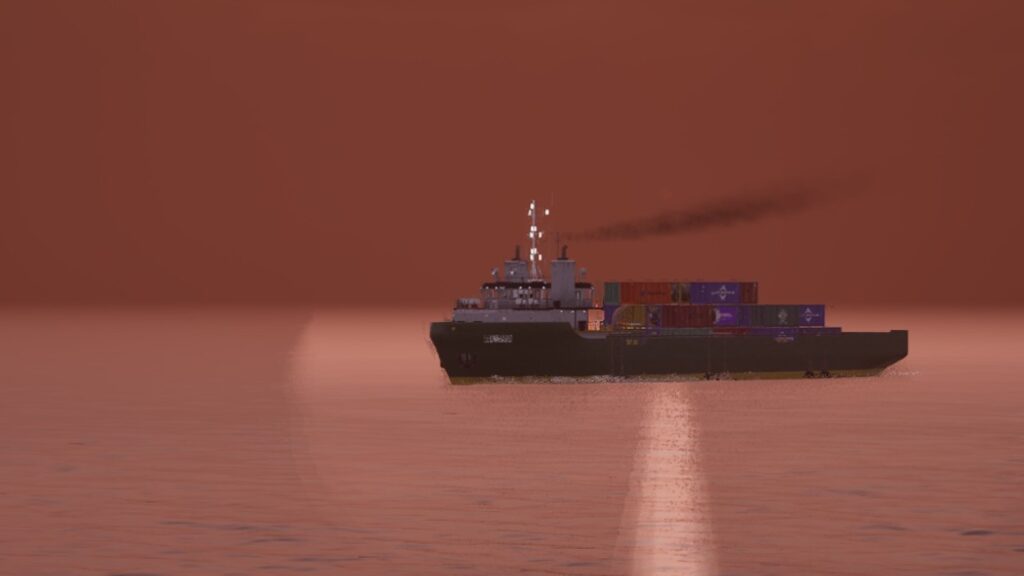
Seafarer is not a simulation of actual commercial shipping; it tells you that up front. There’s no shipping lanes, no regulations, no balancing of cargo so that the ship doesn’t capsize, and initially, no other crew.
Seafarer takes place in a fantasy country where regulations don’t exist and the sea police can look through binoculars and figure out that your ship logs were misplaced.
You play as an experienced helmsman who has come back from a break and the pleading of your good friend and professional ventriloquist, Teddy, who has managed to sell his soul for the down payment to a decrepit cargo ferry, the Herbert. He’s asked you to take command, load cargo, unload cargo, sail to different ports, keep the old boat running, and help out other ships in need.
You can say no; there are two tracks to the game – the commercial shipping game, where you bring cargo from port to port on increasingly larger freighters, and the Tide Patrol game, where you skipper patrol boats, fire boats and tugboats in aid of the freighters. You can swap between these paths as often as you like; experience and money counts for both. According to the Steam achievements, most players stick to the commercial shipping path, and the same is true for me.
Once out of the tutorial, you have your choices of missions. Loading or unloading jobs put you high up on a crane moving cargo containers between trucks and ships. Ferry jobs also have you loading containers with the crane, securing the cargo, sailing to the destination, unsecuring the containers and loading them onto trucks.
Until you unlock fast travel at level 4, most of your time is spent at the helm, keeping the ship on course and keeping an eye out for ships in distress. It would be really peaceful if the ship could keep to a heading, but, alas, this feature is not part of any of the ships I tried. (It may be a feature of higher level ships). So most of the time, you will be sitting in front of the screen for an hour or so, constantly making minor course corrections to deal with shifting winds, weather and currents.
The tedium is broken up every so often by engine trouble. Until you hire a ship’s engineer, this is your job to handle. You should have bought supplies (oil, fuel, air filters, oil filters) at dock. If you have these items, you can run around to the engines and do what needs doing. If you do not have these items, you have to signal Tide Patrol to come get you for massive penalties.
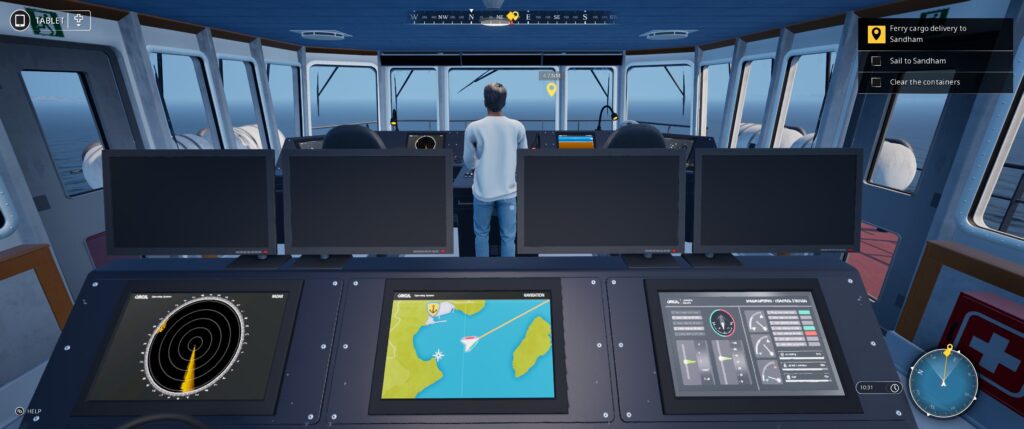
With an engineer hired, you can send them to deal with engine troubles and they will do their best. You can also hire an officer who will steer your ship and who clearly has more patience than I do. About the only job left for you to do is loading and unloading cargo and plotting the course. Once fast travel is unlocked, you can plot a course and then follow it quickly on the map screen. You can’t exit to see your container ship speedboating along the path; presumably it just simulates you playing on your phone and now and again looking up to see if you’ve crashed into anything.
Fast travel doesn’t allow you to obtain the “blue” mini quests that sometimes pop up as you sail, and this could be the loss of some easy money and XP.
You want the money and XP. You definitely do want to unlock fast travel as quickly as possible. Your ship also needs fuel and supplies and repairs, especially if you come skidding into the dock as I like to do. New ships, both for the shipping and Tide Patrol tracks, become available as you level and cost a considerable amount of money, but also earn you much more.
But I do like the game
Seafarer: the Ship Sim is very much a comfort game, similar to other simulators like the truck ones I mentioned, the farming ones, the bus one, etc. You get into a comfortable rhythm and just let the time go by. Fast travel and crew means you can, if you like, just focus on enjoying the scenery (which does look fairly nice) while the ship moves itself to the new port, or take the helm and head out to sea where a stranded ship needs your help, or check out points of interest. Taking the ship in and out of the harbor will always be your job alone, and nailing the crane game feels good.
But there is one element I would really like to see.
What I would like to have happen is something that you can do on the trucking simulators; run your own shipping concern and have your own fleet of ships taking on jobs without you having to get up from your desk, unless you really want to. I don’t know if that is something that happens. Your friend Teddy, that master of ventriloquism who never moves his lips while speaking, currently has that job, but, well, you’re captaining the ship and Teddy is not. You could just show up at a new port and use the ship as collateral so that you could start your own shipping company and just hope Teddy writes the ship off.
It worked for P. T. Barnum.