
“Revolutionary drop-style card crafting in the Dungeon Drop universe. Drop 80 part cards to create Widget’s chaotic workshop, then use one finger to pull perfect components for your robots and golems. Unique spatial set collection meets strategic card crafting.”
This is what it says on the tin. Well, on the box, a box about the size of a tarot card box. This is the follow-up to “Dungeon Drop”, a game where you drop colored cubes from a height to form a dungeon that you then explore, the game that first created the drop-style game, based around dropping things. In Widget’s Workshop, instead of dungeon cubes, you drop… robot parts.
The goal of Widget’s Workshop is to build robots from parts scattered randomly on the table between the 1-5 players. The parts themselves are one of body, left and right arms, and left and right legs. Each part has an element (leaf, water, air, fire), a specialty (strength or speed) and guts (gears or meat). Construct a robot that matches four or more of any of these three areas scores point; a robot that has parts matching all of element, specialty and guts together scores the maximum, 30 points.
First player to construct three robots gets a five point bonus, and everyone else gets three more turns to complete any robots under construction.
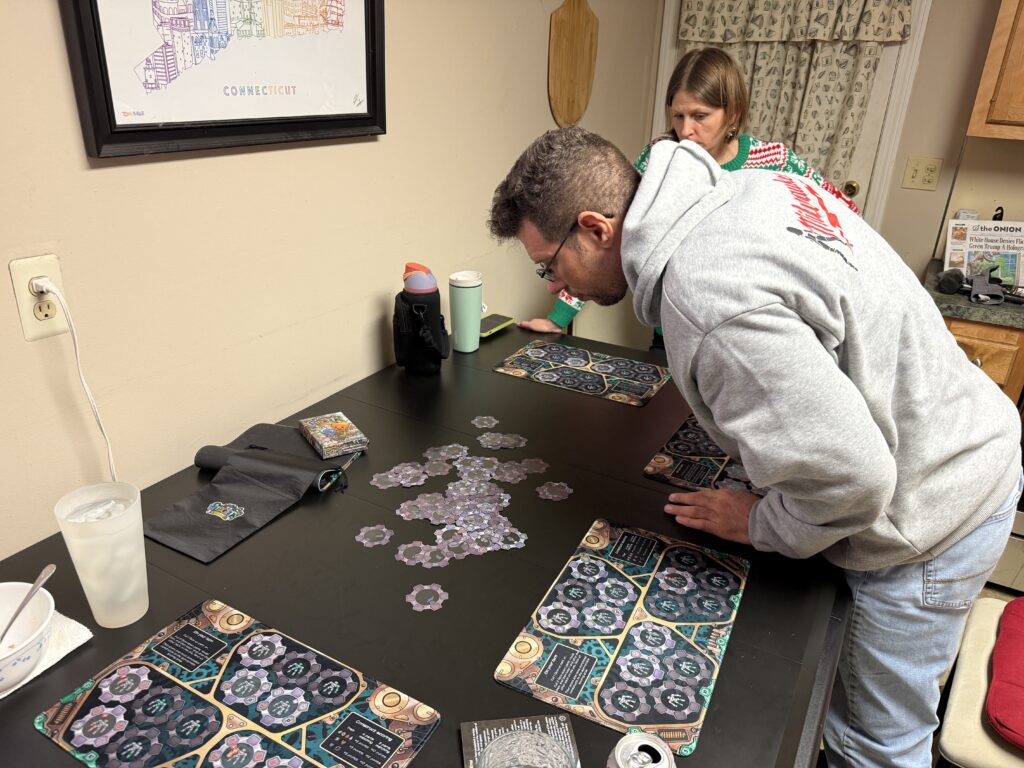
The twist is that the robot pieces are in a scattered pile; some may be hidden beneath others, some may be flipped upside down so that you can’t see its types; some may also be on other player’s boards. Each turn, you may use a single finger to slide a face-up part out of the pile and add it to one of your three construction bays, or use two fingers to slide two face-down pieces from the pile, choose one, and carelessly toss the other back in the pile, face-up.
That’s it; that’s the game. The fun part is trying to psych people out, and perfecting the noble art of not looking at that ONE PIECE YOU NEED RIGHT THERE DON’T YOU BE TOUCHING THAT BEFORE MY TURN and so on.
It’s a fun, light, game. Each part contains part of a name. The centers of the pieces are translucent, so when you stack them up, it reveals a unique name. Shouting out the name is part of the fun.
The neoprene playmats were part of the Kickstarter campaign and don’t appear to be sold along with the retail version of the game, which is sad. The game comes with tarot-sized playmats that can be assembled to provide an alternate, but the neoprene mats are what you want. (The game and the set of neoprene maps can be bought from the publisher at https://phaseshiftgames.com/).
You’re not going to build a campaign around weekly Widget’s Workshop nights, but if you have the right number of people around and they want to play a game that doesn’t take forever to learn or play, you could do a lot worse.