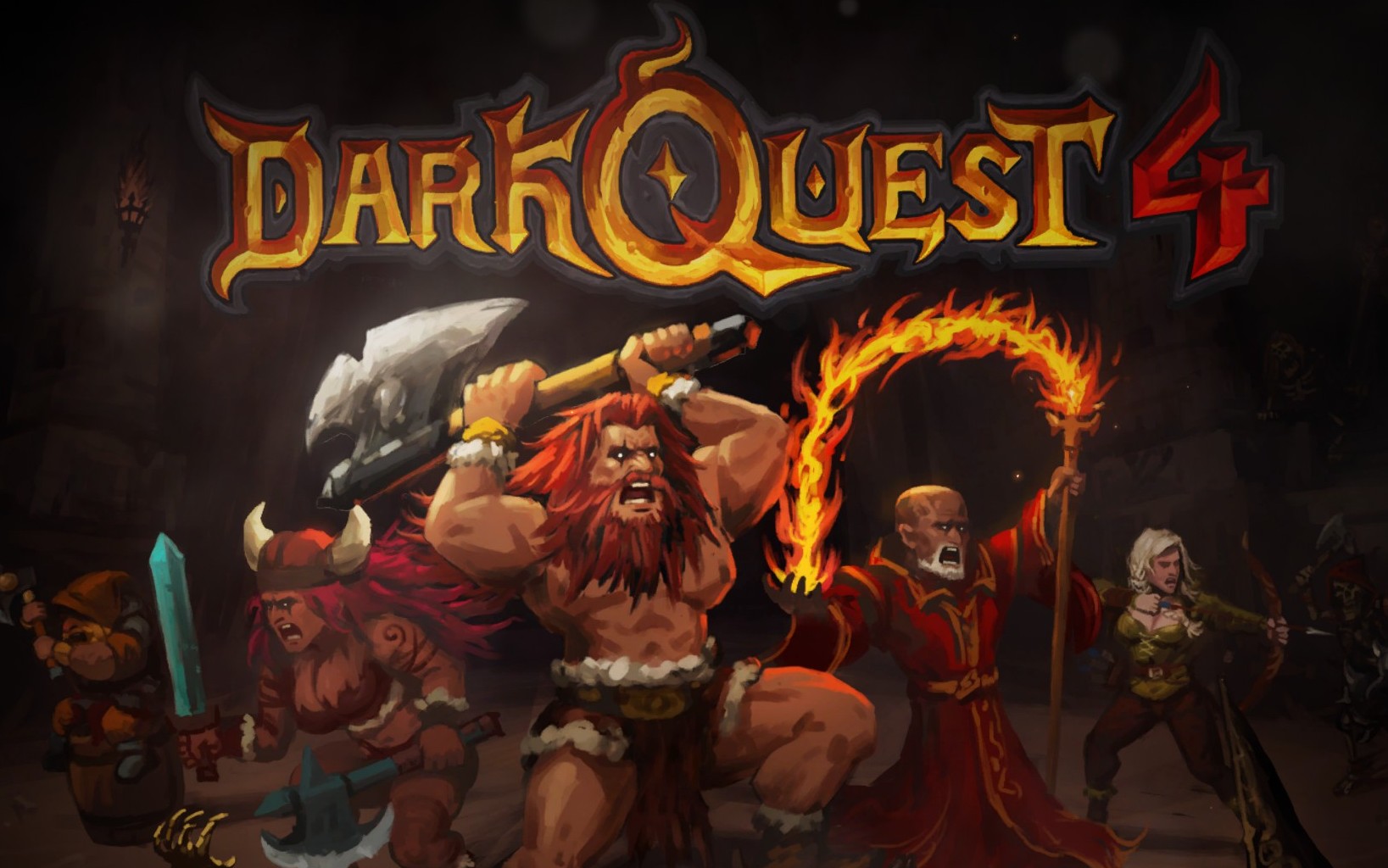
I admit that I’d never heard of the Dark Quest series before, which is bizarre, as I am a huge Hero Quest fan. We’re even about to start a new campaign in real life. So… when I finally did hear about it, I wishlisted it immediately. The demo dropped today, and I dropped everything to play it.
If you’ve never heard of Hero Quest, here’s the skinny: It’s a party-based tabletop adventure game that plays like a stripped-down Dungeons & Dragons. One player (and it doesn’t always have to be the same player) takes the part of Zordan, an evil sorcerer who sets up the board and moves the monsters around according to precise rules. The other 1-4 players take on the four adventurers (with players doubling up as needed). The base game comes with four classes – barbarian, wizard, elf and dwarf, with expansions adding many more. The extensive scenario books direct the layout of the board, the loot, monsters and so on. The Zordan player sets the scene and that’s it. Each scenario takes about an hour to play, and there’s time in between to shop.
I was actually a little shocked to find out that there is no official digital version more recent than the 1991 HeroQuest game – which, admittedly, is an excellent adaptation of the base game’s campaign. (And you can play it right now, for free).
Into that void comes Dark Quest. Each of the games in the series is similar – you choose a party of three adventurers, and take them on a turn-based adventure full of traps, encounters and mysteries. I haven’t played any of those, though as I’m writing this, Dark Quest I and II are dirt-cheap.
Earlier games in the series seemed to rely on procedurally generated dungeons in the vein of Rogue and NetHack. This fourth version delivers a campaign of handcrafted dungeons, with Steam Workshop integration for many more, including those you make yourself. It supports only three characters instead of four – the elf has apparently returned to her forest with trees of silver, though the demo promises the full game will allow choosing from many more characters than just the starting barbarian, wizard and dwarf.
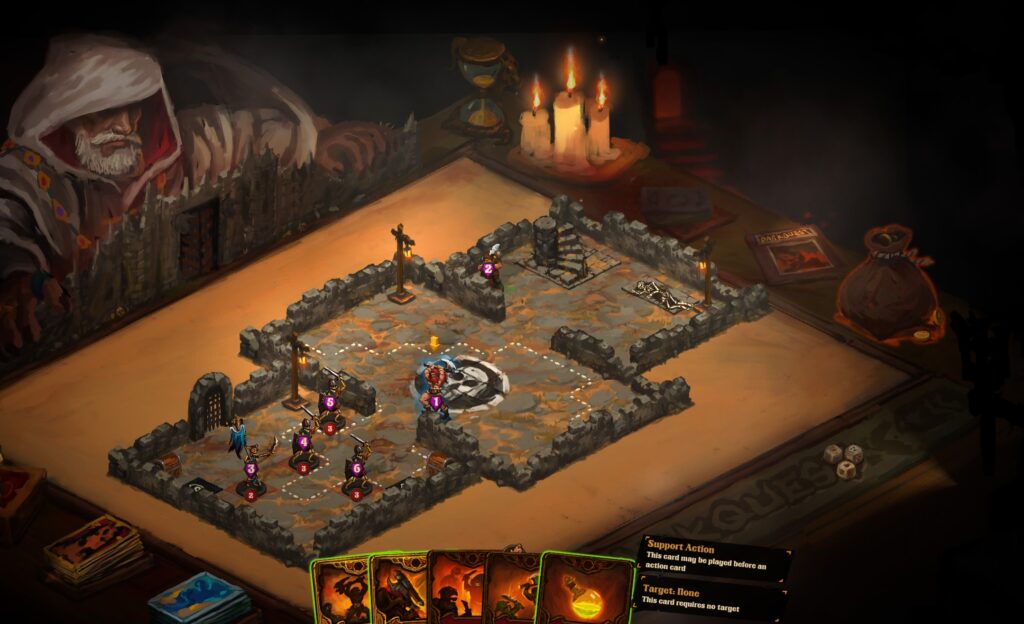
I played through all three of the demo scenarios a couple of times, and then I did a couple scenarios in the 1991 Hero Quest game to compare.
Dark Quest, for all that it comes decades after the Hero Quest game, is definitely on the stripped-down side of things. There is no searching for traps or secret doors, for instance. Even if you know from a previous playthrough that a trap is in a certain spot, there’s no way you can avoid tripping it. I assume there will be armor and weapon upgrades, but that is an assumption as I didn’t notice any sort of inventory.
Action cards take the place of what Hero Quest did with magic items and spells; every character can buy up to two from a selection. The barbarian and dwarf both get hard hitting melee attacks from cards. The wizard gets a spell that can hit monsters anywhere on the screen. The dwarf can play Solid Snake with barrels.
Each character has their own stats; the dwarf has a better chance of not being affected by a trap, so he should always be in front when exploring. The barbarian has the best health and physical defense; the wizard has the least health but best magical defense.
My standard approach to all the three missions in the demo was: let the dwarf explore, keep the wizard well in back. Barbarian to open doors. Dwarf sets exploding barrel of fun while everyone hides. Wizard explodes enemies from out of sight, monsters get exploded, finally reach barbarian, who is in a place where he can’t be surrounded. Dwarf helps. Wizard keeps exploding stuff. When this worked, I could get through even the hardest scenario without taking much damage.
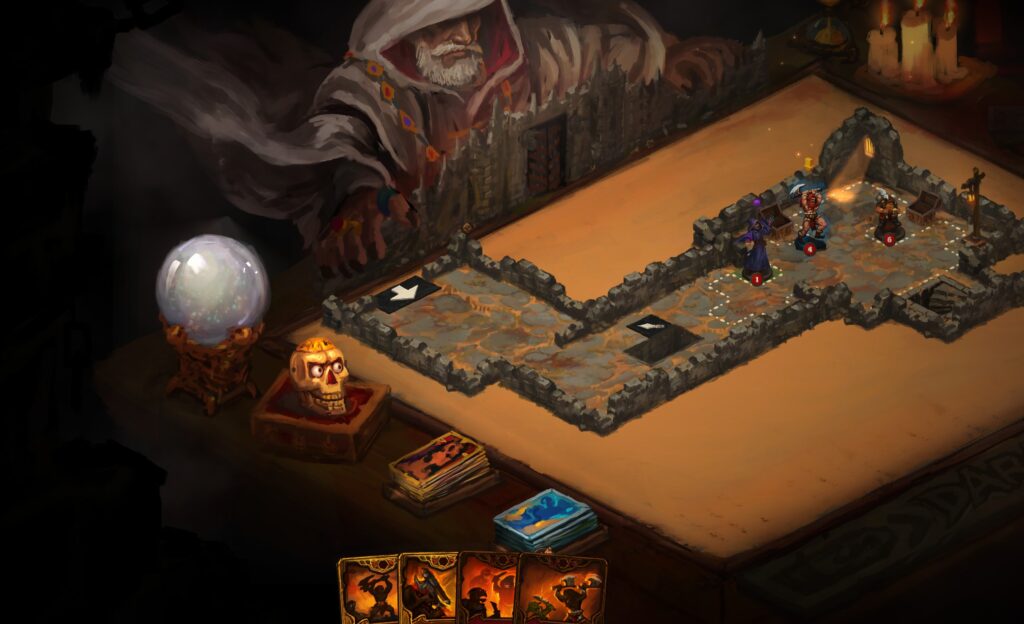
The full game will allow up to three players, which could be fun. The scenarios in the demo only take a few minutes each, which is fair because, first time through, before you know where everything is, health isn’t going to last. There are no healing spells and the health potions only heal 1-2 health each, and each character can only carry one potion. The characters don’t appear to level up or gain stats. This tracks with Hero Quest, which hid all character progression behind equipment.
Which had the unfortunate effect that, once you had earned the good equipment, none of the scenarios posed much of a challenge anymore.
I haven’t seen anything past the demo, and I’m sure there’s many, many things we can’t try out. For instance: there is a suspicious looking blacksmith in the main camp, so I’m certain gear will happen. There is also a bard, and who knows what they do.
That said, the scenarios were short enough that it was worth doing them a couple of times to get good at them and earn a little extra cash (not that it was really needed in the demo), but it’s nice to know scenarios can be replayed. The previous game, Dark Quest 3, is about US$19 right now, which isn’t bad, though it has to be said that DQ4 looks a lot better, and you can’t beat handcrafted adventures over the computer generated ones.
Day 1 purchase? Probably not. I do have and play actual physical Hero Quest regularly, and that game is currently available on Tabletop Simulator as well, though that kind of requires other people. But if a couple of friends wanted to play it, I wouldn’t say no. I imagine I’ll pick it up some weekend when I want to have a little retro fun and see what all the secrets are about. But give the demo a shot – maybe it’s the adventure game you didn’t know you were missing. It’s available on Steam right now.