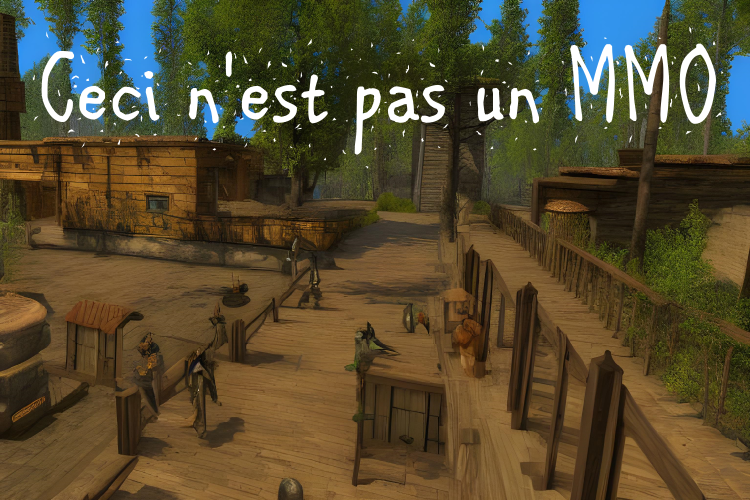
Since I ran out of credits for the month at Dall-E 2, I’ve been using Midjourney. Tonight, I went to Stable Diffusion, which is free and only took a dozen tries to make something that looks like it might have come from an MMO.
There’s some questions over yesterday’s post over my definitions of an MMO. So today, I want to explain what I mean when I use the term. I’ve changed what I think of, of an MMO, since I started playing them. And the official definitions are all over the place.
Anyway. Topology. Imagine a super stretchy substance. If you have a shape made of this stuff, and you can stretch it to form another shape – say, make a cube into a sphere – those things are topologically identical. But you couldn’t make a cube into a donut; the stuff is stretchy, not sticky, so a cube and a donut are topologically different. Okay?
To make a definition of an MMO, we need to say what elements are of an MMO, and then apply it to any specific game and see if that qualifies.
One dictionary defines MMORPG as “an online role-playing video game in which a very large number of people participate simultaneously.”
There’s a bunch of concepts in there they don’t define. Role-playing? You take on a role? Call of Duty does that. Very large number of people participate? Yeah, millions of people play COD at the same time. Is Call of Duty an MMO? By this definition, it is. It is topologically identical.
Another definition says an MMO is a game where you “traverse a virtual world, complete quests, earn rewards, and interact with other players.” All those things are in Call of Duty. Every single one of them. Still no donut hole.
Yet another definition: “any story-driven online video game in which a player, taking on the persona of a character in a virtual or fantasy world, interacts with a large number of other players.”
My son plays Call of Duty a lot. There’s a lot of story going on. Nazi scientists triggering extraplanar zombie invasions was one plot he played a lot. Well, that sure sounds like a story. As you worked through the missions, you saw more of the story. Virtual or fantasy world? Yeah. Interacts with a large number of other player?
This is why I brought up the topology thing. How many players does a MMO player really interact with? Most times when I play FFXIV, the number of players with whom I interact is zero. If I join a 24 person raid, then that number is 23. I don’t think you can get 24 people in the same COD instance at the same time, but for sure, you can in Fortnite. You can get a hundred people together in that one, which would be a pretty decent night for an EverQuest server these days. (But EverQuest would be an MMORPG even if only one person was logged in – even if none were.)
Another definition: “MMORPG refers to games that feature millions of players occupying the same game world.” Yeah, this isn’t true for EverQuest, which is an MMO. I’m pretty sure no game has millions of players occupying the same game world.
So let’s make a new definition
But before I do that, why does it matter how broadly we define an MMO? If we start excluding games, we run the risk of mummifying the whole genre. On the other hand, if every online game is an MMO, there’s no meaning to it. I kinda bristle when every other single player on Steam is called a roguelike. No it’s NOT. But that’s fine, as there is a definition of what is a roguelike, the Berlin interpretation.
It’s not a checklist. It’s a list of high value items and low value items, and if you have enough of them, maybe you’ve got a roguelike. But in the annual 7DRL game jam, the bar is, “do you honestly think your game is a roguelike?”
So a game is an MMO if it says it is? Well, Minecraft does not say it is an MMO, but it clearly is by any measure.
A world you can explore. The world isn’t different every time you log in. An explorable world is, to my mind, the number one quality of an MMO. It can be fantasy, realistic, SF, doesn’t matter. You can explore it.
Multiplayer. I don’t think the original definition of “massively” meant millions. I think it meant hundreds. There have been MMOs that I doubt ever had more than a dozen players at a time, if that – I’m thinking the Love MMO, for one. The people with whom you interact should definitely have the possibility of being a stranger.
Friend list. Call it a guild, friend list, or whatever. You should have some way of playing with people you meet more than once.
Online. Well, yeah.
The ability to chat. This is a big one. You have to be able to get to know your fellow players.
Character customization. I’ve played a bunch of MMOs where you just picked your character from a list, based on class. They all looked the same, maybe the gear was different. These were typically 2D MMOs and were more like arcade games. You should at least be able to pick your name, and you should be able to make your character look different than everyone else’s characters.
Story? This comes up a lot. Early WoW had a lot of stories that were mostly self-contained. Early EverQuest had somewhat fewer stories, and they were typically pretty short. Both were mostly told through quests.
Fishing. I’ve heard it said that all real MMOs let you go fishing.
Is COD an MMO? Well, no, the world isn’t explorable. Is Dungeons & Dragons Online an MMO? No, because the world is not explorable; it’s all instanced. It calls itself an MMO, though.
Now all that’s left is to assign point values to all those things, add them up, and set an over/under point total that determines if it is an MMO or not. But for now, I just want to know if my list makes sense, and then I can figure out if Fortnite and COD are MMOs, and if DDO still makes the cut.