
Today’s “Blaugust” writing prompt comes from Mailvatar at “MMOs and Other Stuff”.
What are some key sources of media (games/movies/etc) that have shaped your worldview?
What a great writing prompt. Because I have the specific answer to that, and it’s stayed with me my entire life.
I blame a lot of things on the Uxbridge Public Library. Their kid’s section was really minimal. It was fine if you were truly little and liked story time, but once you got much past Dr. Seuss and Beatrix Potter, there just wasn’t a lot of stuff.
They did have reading clubs during the summer, and one of those showed me what those little stickers on the spines of the books meant – the one with the spaceship, those books were the good ones.
Sure, there were a scattered few of these books in the kid’s section, down the spiral staircase to the basement. I remember one about someone who got lost in a balloon flight and ended up in a place where people spent their evenings trying to make the best dining out experience for everyone else. (Google tells me that this book does, in fact, exist, and is The Twenty-One Balloons by William Penè du Bois). And naturally, they had Madeleine L’Engle’s A Wrinkle in Time.
I ran out of those books pretty soon. But, upstairs, in the adult section, they had shelves and shelves of rocket stickers. My mom was a big science fiction buff, and she encouraged me to explore. She really, really, shouldn’t have done that. It was there that I was introduced to…
The Three Stigmata of Palmer Eldritch
The sixties and seventies were a weird time to be an adult, I imagine. They were an even weirder time to be a kid.
“Stigmata” wasn’t the first Philip K. Dick book I read. I believe the first one was “Ubik”, but I won’t link that yet because I do want to talk about that.
Dick was insane. He, like contemporary Kurt Vonnegut Jr, believed that what we conceive of as free will is really an illusion, and that our actions and our thoughts are inextricably linked to the flood of hormones and secretions flowing through our bodies, and the various firings and misfirings of neurons in our brains. Dick would eventually come to believe that a cosmic being named “Valis” was controlling us all.
I’ve just read the synopsis of the novel over on Wikipedia, and I do remember the plot better now, but mostly I still remember reading this, outside on our porch, and looking up in a bright summer day and wondering if any of this world was real.
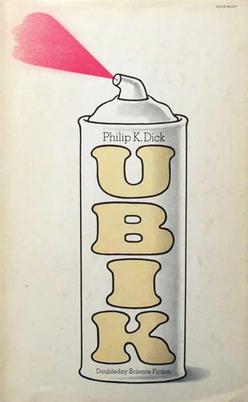
I didn’t dare read more of his stuff for a long time, but eventually “Ubik” drew me in. Again, are we living in a real world, or is this some sort of purgatory, a transition between a life that we cling to even though we’ve lost it, and the next world, full of unknown?
As I grew through a very troubled puberty, I read one last book that at the time seemed to make sense of everything.
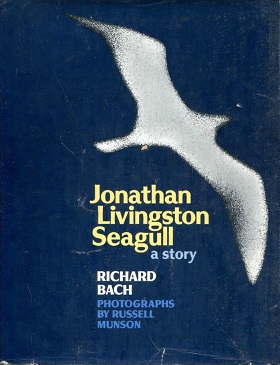
Jonathan Livingston Seagull
This book has become something of a joke in recent decades, but for a kid struggling to make sense of just why life was so fucked up, and why we had to grow up, grow old and die, and how each day seemed like it could be our last – the existential crises that hits every child at some point – this book had the answers.
This world in which we live, says Richard Bach in JLS, is a school where we learn to become better people. When we pass on, we either come to a very similar world if we haven’t learned much, or maybe the next world is a little better. By becoming better people and making the world a good place, we are literally making a heaven on Earth. He would later expand on this in his novel “Illusions: The Adventures of a Reluctant Messiah”, a book I read much later, which leans perhaps too far into the prosperity gospel, new wave stuff.
But where Philip K. Dick forced me to question whether reality was actually real, Richard Bach had the answer: It doesn’t matter what is real. It only matters what you do, and that you live each day to the fullest and strive to become better and help others do the same.
I’m at the other end of my life now. I don’t know how much longer I have – nobody really ever knows, though. But, I remember how I felt after I read these books as clear as anything. Philip K. Dick tore apart my young world, but Richard Bach helped me stitch it back together, better than new.