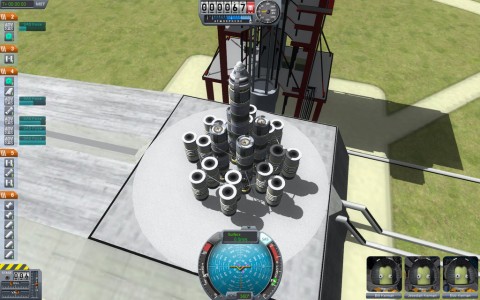
It’s a tense day for the Kerbal Space Program. Three intrepid explorers have been strapped into the Super Booster 3, charitably described in the Kerb press as a “flying bomb”.
In actuality, there’s an excellent chance it will explode right on the launch pad, like the regular kind of bomb.
That’s all in the past, though. The mess has been cleared away. Again. The space program has nearly run out of Kerbonauts, though – these are the last three. It is more important than ever, that they not die.
Right away, anyway.
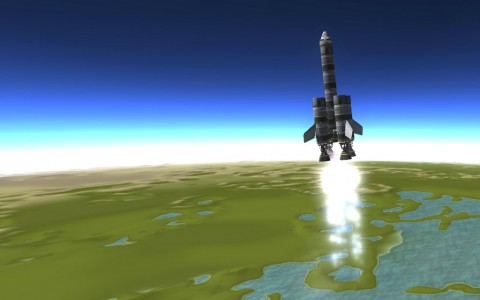
Launch went surprisingly well. Eight solid rocket boosters paired with four mighty liquid fuel engines pushed the bomb spacecraft off the pad and into the clear skies. Twenty five seconds later, the SRBs dropped away while the liquid fuel engines continued. Above the atmosphere, the liquid fuel engines gasped the last of their fuel and were dropped.
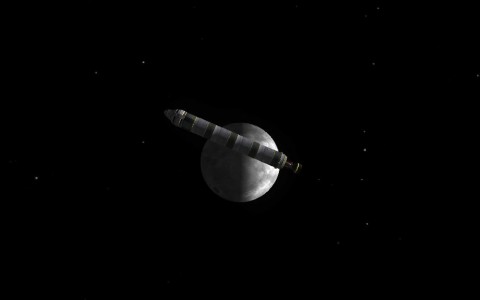
The last stage took over. Previous models of the spacecraft had this last stage boosting from the start along with all the other engines, but this one saves the last engine for breaking out of orbit and landing on the moon.
You don’t just fly places in Kerbal Space Program. You adjust the orbit so that it intersects the orbit of your destination at the same tangent. You don’t land on Kerbin. You choose a ground-intersecting orbit.
I fired the rockets and used the (M)ap display to help select an orbit that would intersect Mun at about the right altitude to grab the spacecraft and give me a base to circularize the orbit and make a controlled descent onto the moon.
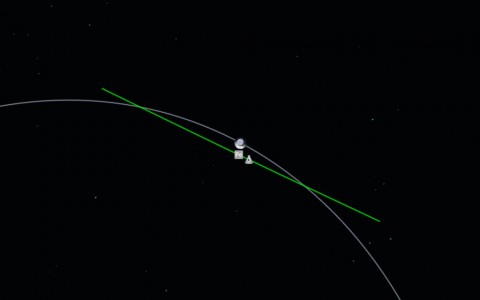
Unfortunately, the space craft was moving too fast to be captured. Instead of going into orbit around Mun, the moon’s gravity swung the craft into orbit around the sun.
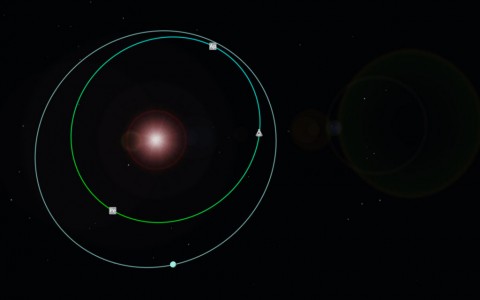
It’s been a very long time since we learned about Kepler’s Laws in high school, but I do remember that inner orbits are faster than outer orbits. This also means that if I can make the orbits match up, then at that particular point, if the tangents at that point are the same, the spacecraft and Kerbin will be moving at the same orbital velocity – and the Kerbals will be saved.
The Kerbonauts have been sitting in their craft for game-years right now, waiting for the one moment when their planet and the spacecraft’s orbits are close enough to use the last of the spacecraft’s fuel to slow sufficiently to be recaptured by Kerbin and come to a final, safe landing.
It’s a game, and the aliens are cute, and if you buy the full version of the game (I am playing the free demo), you’ll have many opportunities to build more capable ships and explore more places and have a little more in-game help with the orbital mechanics.
This game works with the real physics. It IS rocket science. But it’s FUN rocket science! Plus, you get to fly spacecraft that you design, and how much fun is that?