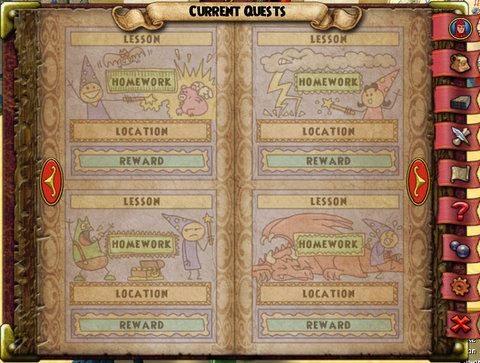
There’s nothing as sad as seeing any empty quest journal. Er, assignment book. We are, after all, all wizards at Ravenwood, and in between saving all the worlds of the Spiral from the renegade Death professor, Malistaire, we’re meant to be getting in our assignments on time and are graded on neatness!
I’ve done all the assignments, been to every alley of Wizard City, every monument in Krokotopia, every rooftop in Marleybone and every temple in Moo Shu.
Many times.
I think I would give up EQ2 and Spellborn together if I could log into Wizard 101 tomorrow and find Dragonspyre open for business.
I even spent the weekend farming Onis for gear I probably don’t need. My alt went from level 9 to 21 pretty much on experience from instances.
So now that I’ve been everywhere and fought everything, what have I learned?
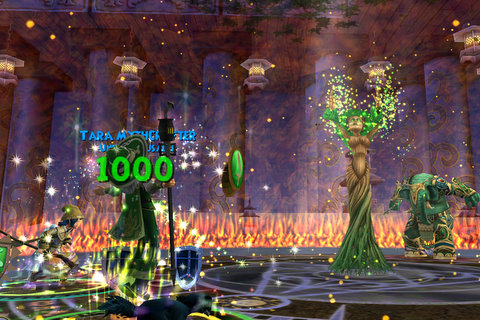
A much-appreciated dryad brings me back from the brink of death in a fight with the Jade Oni.
Every fight is different. Because of the card battle mechanic, no fight ever plays out the same way. Sometimes you win easily; sometimes the cards just aren’t there, but they seem to be there for the other side. Sometimes your Sprite Guardian spends the whole fight healing herself as your life plummets downwards.
Just saying.
Deck construction becomes an art. The best decks are constructed for specific fights, and usually tend to be only about 20 cards or less, nearly guaranteeing the cards I needed and not expecting any surprises from the foes. Fights against unknown enemies or many different sorts at once meant a more expansive and general deck.
The schools of magic of the enemies always called for certain responses. Life beats Balance and Death. Fire beats Ice. Spirit and Elemental magic don’t mix. You can’t effectively ward against Balance. Go Ice if you don’t like taking damage but can take it better than anyone else. Go Storm if you want things to die fast (and wear +Accuracy clothing and accessories at the expense of anything else). Go Myth and never fight alone.
The need to weigh all these factors means fights are never “hit autoattack and get some coffee”. Nor are they especially fast. Sometimes you’d LIKE fights to be over in just a couple of seconds.
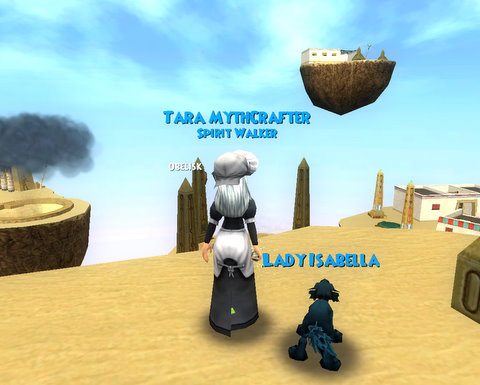
A mystery in Krokotopia: What IS that island? It’s not the Tomb of Storms, that’s to the left and below. It’s not the Krokosphinx – no sphinx (and it’s clearly visible, just not in the picture). It’s not the secret island, because I’m standing on it. It’s a mystery.
Bad parts? The quests are almost always unimaginative kill fests – kill ten cats :) kill these until you get five of this rare drop. Bring this to that person. The missions break the tedium of the kill quests; some of them are pretty imaginative, and they get better as you proceed through the worlds. If only a young wizard could level solely through missions – which have the best loot, usually. To stop players from powerleveling by repeating easy, high level instances, though, KingsIsle added diminishing returns. You get to do any certain mission twice; after that, no experience.
That places an effective cap at leveling. After you have emptied your assignment book and done every mission twice, you’re between 44 and 46, depending on how much additional killing you did. The level cap is 50, but only those who got there before the diminishing returns patch are there now.
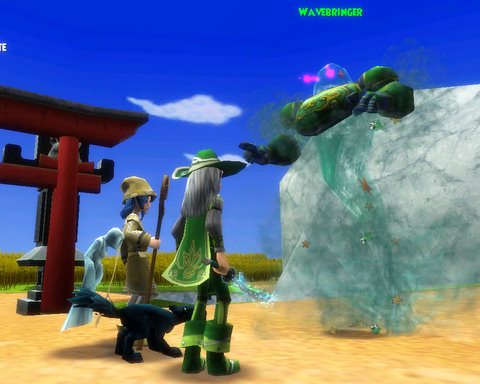
Tara and Allison speak with Wavebringer after defeating the Plague Oni in Shiritaki Temple
This points out Wizard 101’s greatest failing: You can run out of things to do. The diminishing returns patch removed any way to progress your character after a certain point. There’s gear to get, but any specific gear takes so long to get that it takes a Herculean effort to run the same instance just one. More. Time. And then the next.
If gear were tradeable, it would encourage people to gather their friends and keep on fighting the bosses to get their loot. But to do Plague Oni four or five times now and see my class boots keep going to people who can do nothing with them but sell them to a merchant? That’s painful. To run the Krokopatra instance (which is admittedly pretty fun) (you can’t put lipstick on a lizard and you look silly if you try) and to have the rare robe drop for Tara twice but not for Allison who needed it after all the times we ran it (it’s a pretty quick instance)? Disappointing. Crowns armor available for huge sums of gold from merchants, making it so that most people have that armor as a baseline (and a crutch)? Disappointing.
The almost total lack of a community in the game is absolutely distressing for an MMO of this quality. In the name of protecting children from imagined threats (games where kids and adults mix freely, such as World of Warcraft or any game on Xbox Live, show the hollowness of the threat), KingsIsle has made it nearly impossible to meet real life friends in the game without extensive out of game communication. The text filter makes it extremely difficult to discuss how to even play the game in any useful way, meaning to actually play the game well, friends need to use a third party program to talk with each other around the game.
Wizard 101 played with Ventrilo is a different game.
Wizard 101 played with Menu Chat, as you must do when kids join your group, is like trying to sing with your mouth taped shut.
Guilds and clans let people who play many games build a community and an identity through friendship. Guilds are a good way of making real the idea that if I like you and I like her, then maybe you will like her. And you and she like him, so maybe I’ll like him. And maybe when I log on, I can say hi to everyone in my guild at once, and we can perhaps group up and do some instances you need, or decide to take on Kensington just for the fun of it.
Without any community tools, there can be no community, and so Wizard 101 feels emptier than it is.
W101 is a great game, it’s a fun game, it’s an innovative game, but it’s a game that has bought into the hysteria that every adult is a real or potential child abuser, completely disregarding that children are in considerably more danger from people they know in real life than from anyone they might meet playing a video game. That attitude cripples an otherwise amazing game. Adults wonder why they are being suspected of being criminals. Kids wonder why a game company thinks they can’t take care of themselves. Everyone just wants to have fun and play the game with friends.