

The lack of hands is all that is keeping the world’s reindeer from lasering everyone to death. Luckily, THIS reindeer has YOU. Beware.
The header art was used with the permission of the artist, YellowZorro. You can find more of their AoC-themed art here!
All the light you collected yesterday has to go somewhere, and that somewhere is here – a light focusing facility with a thousand different lenses… and a reindeer who perhaps works there? They are very happy to see a human, as while they know what needs to be done, they can’t actually do it.
That, of course, is where you come in.
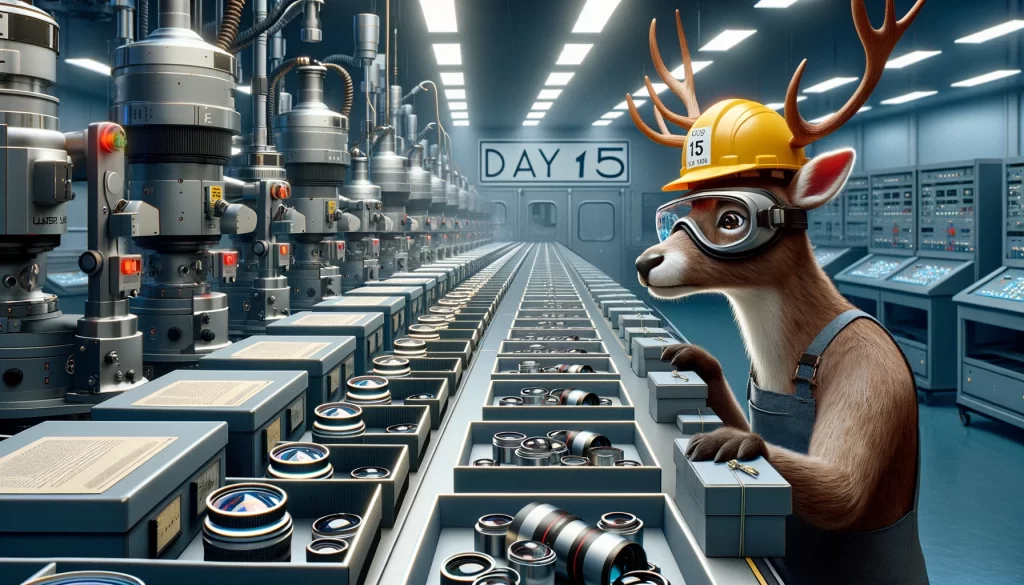 Dall-E 3 redrew the drawing. And this is why AI art is inferior.
Part 1
The input is a vast number of comma-separated values, looking like this:
rn=1,cm-,qp=3,cm=2,qp-,pc=4,ot=9,ab=5,pc-,pc=6,ot=7
The actual puzzle input is much, much more. The puzzle gives instructions on how to form a hash of a string. A hash is simply a way of turning a string into a number. More than one string can generate the same hash, especially in the case of this one, that only has 256 values.
`def deer_hash(s: str) -> int: return reduce(lambda h, c: ((h + ord(c)) * 17) % 256, s, 0)
def part1(): print (“Part 1:”, sum(deer_hash(x) for x in read_data().split(’,’)))`
deer_hash applies the hashing algorithm to each character in turn, using reduce, a function that takes a list, applies a lambda (AKA anonymous function, et al) to each element, and returns a single value.
part1 sums the hashes of the input data.
Part 2
It turns out that the input data are actually instructions. Tokens of the form (=) are instructions to put the lens of focal length in the box numbered deer_hash() and the lens would be labeled with that label as well. The order of the lenses is important, so there is to be no shuffling. Tokens of the form (-) are instructions to remove the labeled lens from the deer_hash’d box.
At the end, calculate the power of each lens, which the product of its box number + 1, its position in the box +1, and its focal length, and sum those up for every lens in every box.
What the puzzle describes is an “ordered hash”. Python’s native dictionary object implements this, so I just made a list of dictionaries, and parsed the commands to add and remove things as necessary.
def part2():
 boxes = [{} for i in range(256)]
 for x in read_data().split(','):
 # use re to find the label, contiguous letters at the start of the string
 label = re.match(r'^[a-z]+', x).group(0)
 box = boxes[deer_hash(label)]
 if '=' in x: box[label] = int(x.split('=')[1])
 else: box.pop(label, None)
 # sum the product of the box number + 1, the position in the box + 1
 # and the lens for each lens in each box
 print ("Part 2:", sum((k+1)*(i+1)*v
 for k, v in enumerate(boxes)
 for i, v in enumerate(v.values())))
The code works as I mentioned. We make the boxes, each with a dictionary inside. For each command, we extract the label (the letters at the beginning of the command), figure out which box we’re working with, and if this is an insert/replace command, doing the needful. Otherwise it is a remove command, and we remove it. Then we score it and done.
A short puzzle for today!
